

The Disposable Air Force
Cheap Drones Have Broken the Economics of Modern War
A soldier hears the drone before he sees it.
That sound matters. It is thin, electrical, almost insulting. It does not have the majesty of a bomber engine or the menace of a ballistic missile. It sounds like a yard tool that wandered into geopolitics and discovered violence.
Yet the men under it react as if a serious weapon has entered the sky, because it has.
A small drone appears above a road. It may cost less than the tires on the fuel truck below it. The truck stops. The driver hides. The convoy disperses. Radios begin to fill with traffic that someone will later call situational awareness, because every military age gives fear a professional title.
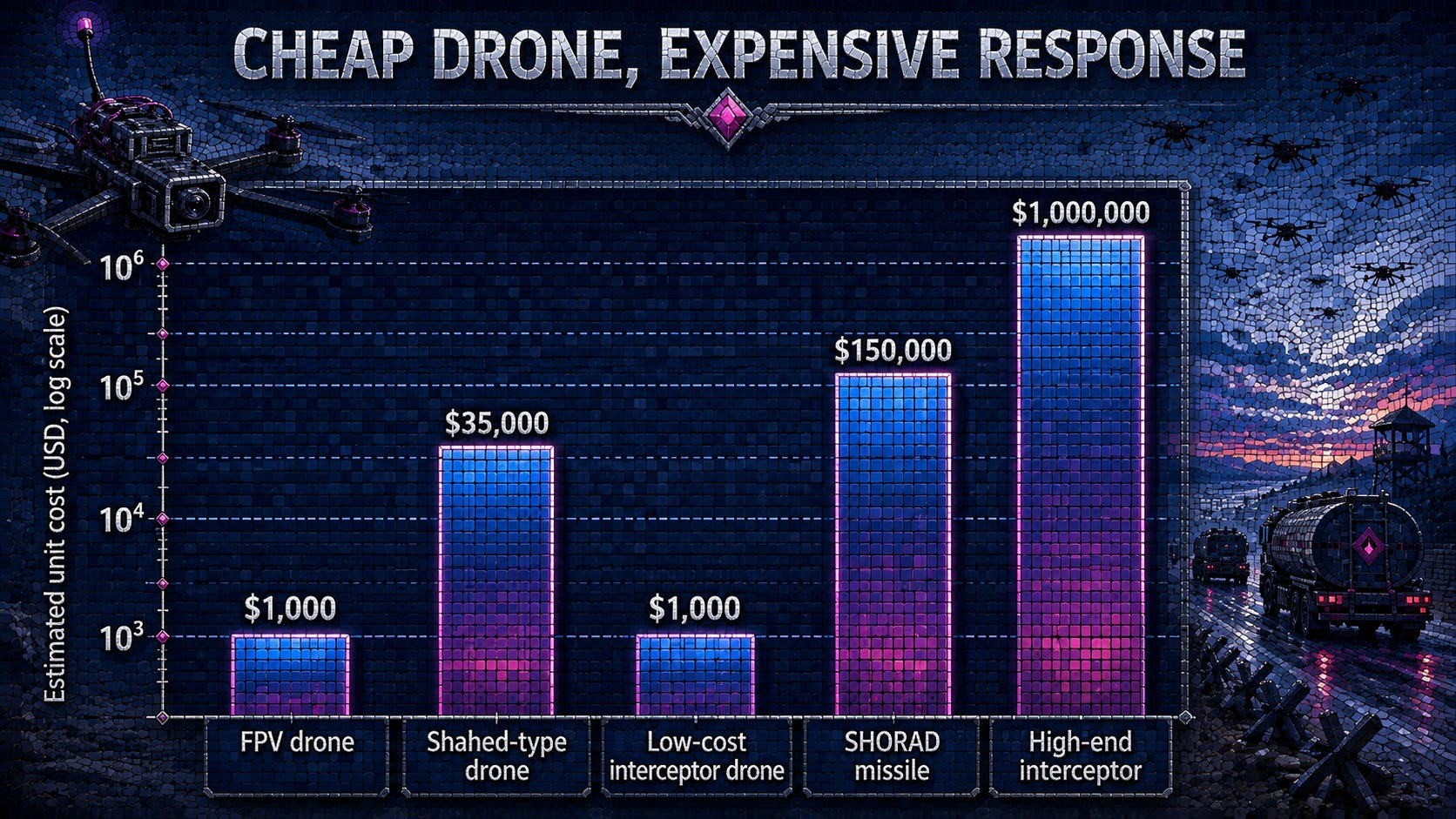
The drone may carry a warhead. It may carry only a camera. Either way, it has already created work. The defender must jam it, shoot it, decoy it, hide from it, or accept the risk that something more violent is now looking through its eyes.
That is the real drone revolution.
It is not the machine by itself. It is the exchange rate.
A cheap drone can threaten a radar, an ammunition vehicle, a command post, or an airbase apron. The defender may answer with an expensive interceptor, an electronic-warfare team, a hasty evacuation, a decoy plan, or a delay that ripples through the operation. The attacker spends small money to create expensive decisions.
That is how cheap drones broke the economics of modern war.
The Real Revolution Is the Cost Exchange
For most of the jet age, airpower was aristocratic. Aircraft were expensive. Pilots were scarce. Maintenance was ritualized. Airbases were enormous. Even a modest air force required money, training, industry, and time.
Cheap drones have not abolished that world. Fighter aircraft still matter. Long-range strike still matters. High-end air defense still matters. But beneath that exquisite layer, a rougher form of airpower has appeared.
It is disposable. It is numerous. It is difficult to count. It does not ask permission from the old priesthood of acquisition offices and platform managers.
The core idea is simple: cheap systems can impose costly reactions.
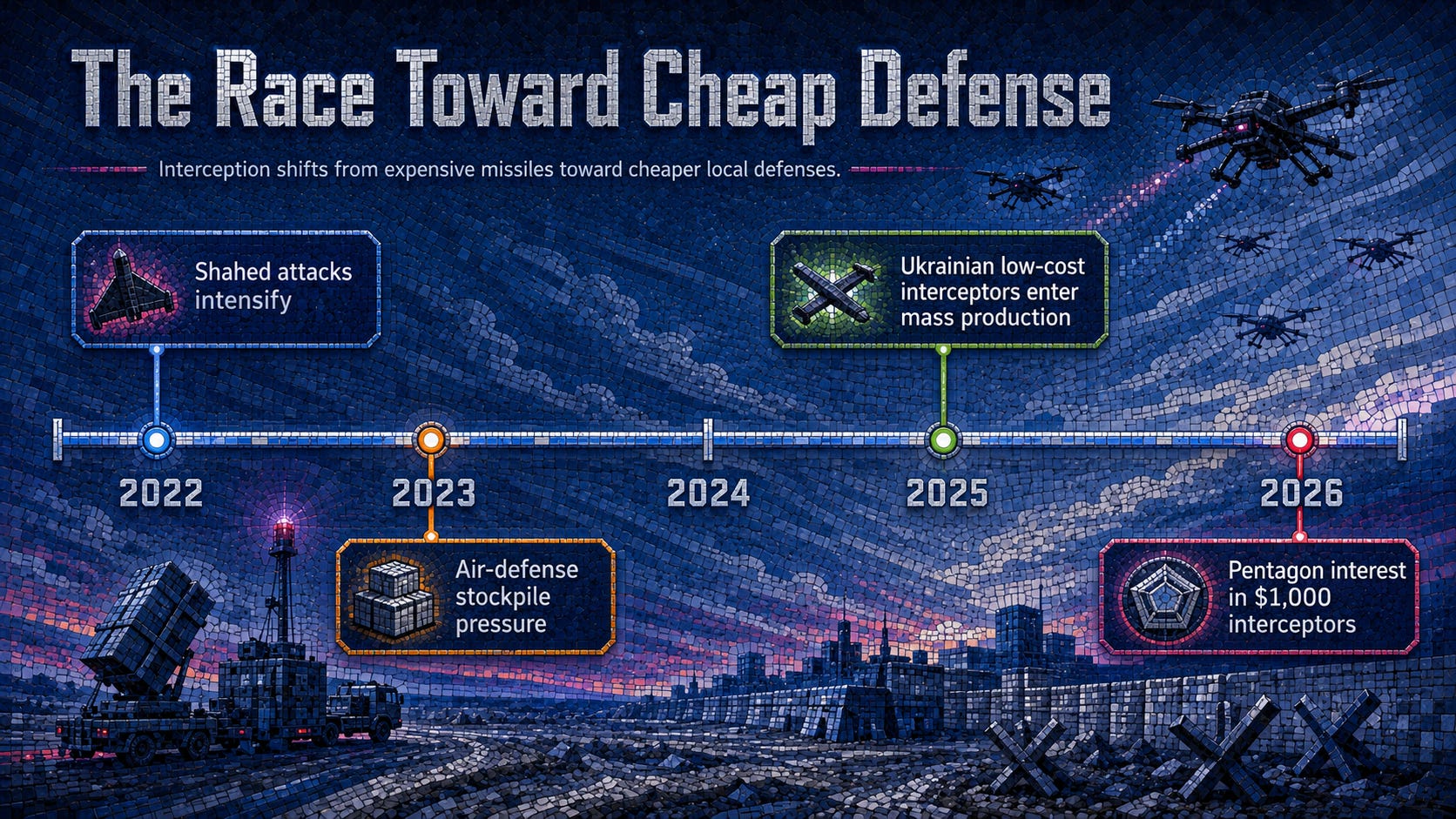
That is why CSIS’s analysis of Russia’s Shahed drone campaign matters. Russia has used Shahed-type drones as an attrition instrument against Ukraine, accepting high loss rates because each wave can force Ukrainian air defense to spend missiles, manpower, attention, and political energy. The drone itself may be cheap. The defensive ecosystem it activates is not.
A later CSIS cost-effectiveness analysis estimated that Shahed-type drone bombardment can be more cost-effective than several missile strike options, especially when measured against cost per target struck. The finding is not that drones are magic. Magic has a better wardrobe. The finding is that drones can make the defender pay a premium to answer a cheap threat.
The Modern War Institute at West Point has rightly warned that cost-exchange logic can be abused when analysts compare prices too crudely. A high-end interceptor may be worth firing if the drone threatens a power plant, headquarters, or air-defense battery. An expensive missile is not wasted if it prevents a more expensive loss.
The better lesson is this: high-end defense must protect high-end priorities, while cheap airborne mass demands a cheaper routine answer.
That is the uncomfortable arithmetic of the disposable air force.
Ukraine Is Teaching the World How to Defend Cheaply
Ukraine has been forced to learn this lesson under fire.
Russian drone attacks have pressured Ukrainian cities, power infrastructure, and military sites. Ukraine could not answer every cheap drone with scarce Western missiles forever. That would turn defense into a financial wound that never closed.
So Ukraine adapted.
AP reported that Ukrainian interceptor drones costing as little as $1,000 moved from prototype into mass production during 2025. That figure matters because it shows the direction of serious counter-drone warfare. The answer to cheap offense must include cheap defense.
This is more than battlefield improvisation. It is a strategic export.
In March 2026, AP reported that Ukraine was offering its drone-defense expertise to U.S. and Gulf partners while seeking high-end weapons it cannot produce domestically. The exchange is revealing. Ukraine lacks the industrial depth of the United States, but it has combat-tested knowledge that many wealthy militaries still lack.
That knowledge is not glamorous. It concerns production loops, operator training, field repairs, electronic warfare, launch procedures, and the miserable little lessons learned when a weapon fails in cold weather or under jamming. In war, greatness often arrives wearing a dirty mechanic’s coat.
Military Times reported that the Pentagon has shown interest in Ukraine’s low-cost interceptor drones. That interest should surprise no one. The most heavily funded military system on earth is studying a country that had to learn drone warfare without the luxury of slow theory.
The workshop has become a teacher.
Attrition Is the Point
The word “attritable” sounds like it was designed by a committee that feared plain English. It means the system is expected to be lost.
That expectation changes everything.
A traditional aircraft is protected because its loss is painful. It costs money. It consumes years of training. It may carry a pilot. It may trigger rescue operations, political pressure, and strategic embarrassment. A cheap drone lives by a different moral economy. Its destruction may be part of the plan.
A commander can send a drone over a treeline, down a road, or toward a suspected antenna site with a different emotional budget. If it is lost, the unit loses money and time. It does not lose a pilot. It does not risk a rescue mission. It does not require a national mourning cycle.
That one fact changes behavior.
A military that can tolerate losses will experiment more. It will scout more. It will probe more. It will accept failure as a cost of information. Cheap drones lower the psychological threshold for reconnaissance and attack.
This is why the Pentagon’s Replicator initiative mattered as a signal, whatever one thinks of its execution. DefenseScoop reported that the Pentagon planned about $1 billion across fiscal 2024 and 2025 for Replicator. The goal was to field large numbers of attritable autonomous systems on a short timeline.
A Belfer Center history of Replicator described it as an attempt to scale needed capabilities through goal-setting, incentives, feedback, and iteration. That language is dry, but the underlying problem is vivid. The U.S. defense establishment knows it must field mass faster than normal procurement culture allows.
The difficulty is cultural.
A cheap drone cannot be treated like a boutique aircraft program. It needs fast contracting, modular parts, software updates, field feedback, repair loops, and permission to die young. A disposable system that has to survive years of paperwork is like a paper cup being asked to complete seminary.
The New Air Defense Problem
Every offensive drone creates a defensive market.
That market is already crowded. There are jammers, spoofers, radars, acoustic detectors, optical trackers, guns, interceptor drones, directed-energy concepts, and net-based systems. The variety is impressive. It also reveals the problem. No single answer is enough.
Electronic warfare can disrupt drones, but it does not erase them. Jamming can break a control link or deny a protected area for a time. Then the attacker adapts. Frequencies shift. Navigation methods change. Autonomy reduces dependence on live control. Fiber-optic control methods appear in certain tactical settings and dodge radio jamming altogether. The defense must keep moving because the offense keeps mutating.
Kinetic defense works, but the price must fit the target.
That is why the U.S. move toward drone-on-drone interception matters. In January 2026, the Pentagon announced the first Replicator 2 purchase as DroneHunter, a reusable AI-enabled interceptor drone designed to track and capture small UAS threats with a tethered net. The product itself is less important than the direction of travel. Counter-drone defense is becoming its own mission layer.
The institutional structure has also shifted. Breaking Defense reported that the Defense Autonomous Warfare Group had absorbed Replicator into a broader autonomous-warfare push. Defense One reported that Replicator was dissolved in late 2025 and absorbed into that newer structure.
Names change. Budget lines move. Acronyms reproduce in captivity.
The pressure remains.
Militaries need a cheap defensive layer that can survive repetition. High-end interceptors still matter, especially against high-value threats. But the routine answer to cheap drones cannot be luxury firepower. That path leads to exhaustion.
Passive defense returns here with surprising force. Camouflage matters. Dispersion matters. Decoys matter. Overhead cover matters. Emission control matters. The drone is looking for contrast: heat, motion, radio emissions, visual patterns, and careless routines. The defender’s job is to become boring to the machine.
It is a humble sentence. It may save lives.
The Ground Force Now Owns a Piece of the Sky
Cheap drones also push airpower downward.
Small units can now use aerial reconnaissance without waiting for higher headquarters. A platoon can check a treeline. A convoy can inspect a road. An artillery crew can observe effects. A headquarters can watch an approach route. Ground units have become direct users of airborne sensors.
That changes command culture.
The Australian Army Research Centre has argued that drones must be absorbed into doctrine, training, planning, and investment rather than treated as gadgets. That is the heart of it. A warehouse full of quadcopters is not a modern force. A unit that can task drones, interpret feeds, connect them to fires, repair them, replace them, and operate under jamming has crossed into a different category.
The camera feed creates its own danger. Live video feels authoritative because it is immediate. It can still mislead. A drone sees a slice of the battlefield, not the whole fight. It may miss what is under cover, confuse decoys for targets, or seduce commanders into micromanaging the visible while the important moves elsewhere.
The old disease was map worship. The new disease has a battery indicator.
Still, the tactical advantage is real. A unit that sees first often shoots first. A unit that watches a road can punish movement. A unit that corrects artillery through drone observation can turn ordinary fires into a far more precise threat. The drone’s most important weapon may be the coordinates it passes to something larger.
The Workshop War
Drone warfare rewards fast learning.
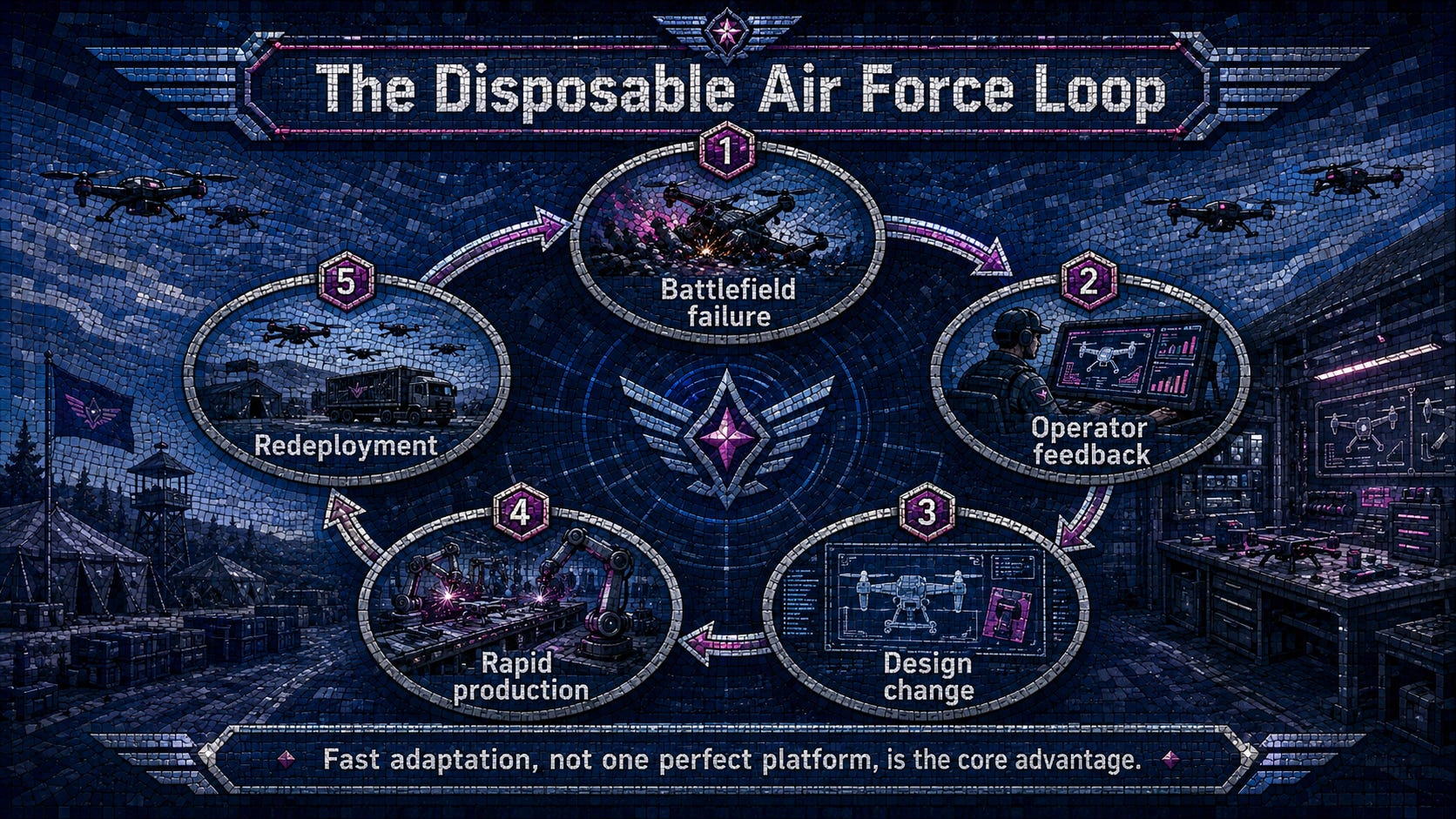
A design fails under jamming. The frequency changes. A camera performs poorly in fog. The sensor changes. A warhead mount breaks. The mount changes. Operators complain that a launch procedure is too slow. The procedure changes.
This is the workshop war.
UNSW’s 2026 discussion of drone warfare in Ukraine stressed the speed at which drones have changed battlefield practice, drawing on accounts from Ukrainian soldiers and commanders. That speed is the important fact. Drone warfare is not a stable product category. It is a contest of adaptation.
The decisive loop runs from battlefield failure to design correction to production to fielding. If that loop takes weeks, the force learns. If it takes years, the force produces a lovely report for the archives.
This places new pressure on defense firms. Companies that understand modular design, secure control links, field repair, cheap sensors, and fast software updates will matter. Companies that try to turn every small drone into a jeweled invoice may still win contracts, because this is earth and not paradise. Yet the battlefield will judge them with less courtesy than a contracting office.
The lesson for wealthy militaries is severe. A perfect system that arrives late may be less useful than an imperfect system that arrives while the enemy is still vulnerable. That does not mean standards vanish. It means the standard must fit the lifespan and mission of the system.
A drone expected to survive one flight should not be governed by the same instincts as an aircraft expected to serve for thirty years.
Rear Areas Are Becoming Less Rear
Cheap drones give weaker actors new ways to create strategic pressure.
A country without a first-rate air force may still threaten airfields, ports, logistics nodes, radar sites, and energy infrastructure. That does not make it equal to a major power. It gives it disruptive options.
The Lowy Institute’s analysis of modern drone warfare argued that Ukraine’s Operation Spiderweb showed how short-range drones can attack areas previously treated as safe, including airbases deep inside national territory. The message is grim and clear. Rear areas are becoming less rear.
A modern airbase is a dense concentration of expensive vulnerability. Aircraft, fuel, munitions, maintenance crews, communications, and command systems sit together because high-end airpower requires organized support. Cheap drones do not need to destroy the whole base. They can interrupt sortie generation, damage exposed assets, force dispersal, and create images that travel faster than official statements.
The camera deepens the effect.
Many drones record their own attacks. The munition becomes its own media team. A burning aircraft on an apron may matter tactically. The footage may matter politically. It can influence morale, donor confidence, alliance debates, recruitment, and enemy propaganda.
The drone carries explosives in one compartment and humiliation in another.
Space and Cyber Sit Behind the Drone War
For Orbital Estimate readers, this is where the story widens.
Cheap drones are physical systems, but many depend on a digital and space-enabled stack. Satellite navigation, communications, imagery, weather data, mapping tools, cloud processing, battlefield applications, and electronic-warfare resilience all shape drone operations.
A cheap aircraft can sit atop an expensive network.
That network can be jammed. It can be spoofed. It can be hacked. It can be denied through attacks on the ground segment or disrupted through spectrum congestion. The drone may cost little, but the system that makes it useful may be fragile.
This is why drone warfare cannot be understood as a narrow air-domain issue. It touches spacepower, cyber defense, supply chains, software, and electronic warfare. A drone strike may begin with satellite imagery, route through a tablet, rely on commercial components, fly under electronic attack, and end as a video clip processed for public release.
The kill chain and the media chain are starting to overlap.
That overlap should worry defense planners. The disposable air force is not merely a cheaper way to attack vehicles. It is a distributed sensor-strike-media system that pressures military assets, public morale, and policy decisions at the same time.
What Defense Leaders Should Do
The first lesson is that drones must be part of the force, not an accessory attached to it. Units need to train with them under jamming, bad weather, battery shortages, operator fatigue, and ambiguous targeting conditions. Commanders need to learn how to use drone feeds without becoming hypnotized by them.
The second lesson is that counter-drone defense must become cheap enough to repeat. High-end interceptors remain necessary for critical threats, but routine defense against cheap drones requires a lower-cost layer. Ukraine’s $1,000 interceptor model and the U.S. DroneHunter purchase point toward the same principle.
The third lesson is that production tempo matters as much as platform quality. The state that can learn from failure and modify systems quickly will outpace the state that freezes requirements too early. A military that cannot revise cheap drones quickly will end up buying yesterday’s assumptions at tomorrow’s prices.
The fourth lesson is that drone warfare must be tied to space and cyber planning. Communications, navigation, imagery, cloud processing, and electronic warfare are part of the drone fight. A commander who treats the drone as a standalone aircraft is missing the architecture that gives it power.
The Strategic Forecast
The next decisive airpower advantage may belong to the force that can lose aircraft at scale without losing operational rhythm.
That does not mean crewed aircraft are obsolete. It means the sky now has a cheaper lower layer, and that layer is too important to ignore.
Watch whether militaries field low-cost interceptors in serious numbers. Watch whether drone lessons move into doctrine. Watch whether procurement systems create fast lanes for attritable systems. Watch whether bases and logistics sites receive serious counter-drone protection. Watch whether commanders treat drones as part of the kill chain rather than flying cameras for after-action videos.
Cheap drones have broken the old economics of modern war by making expensive systems react to inexpensive threats. Their greatness is grim. Their majesty is mechanical. Their effect is larger than their size.
The future may still contain exquisite aircraft, stealth bombers, and high-end missiles. Beneath them, a disposable air force is taking shape.
It arrives with a thin electric whine over a road.
Then the expensive decisions begin.


